
 2022
2022 Global Search
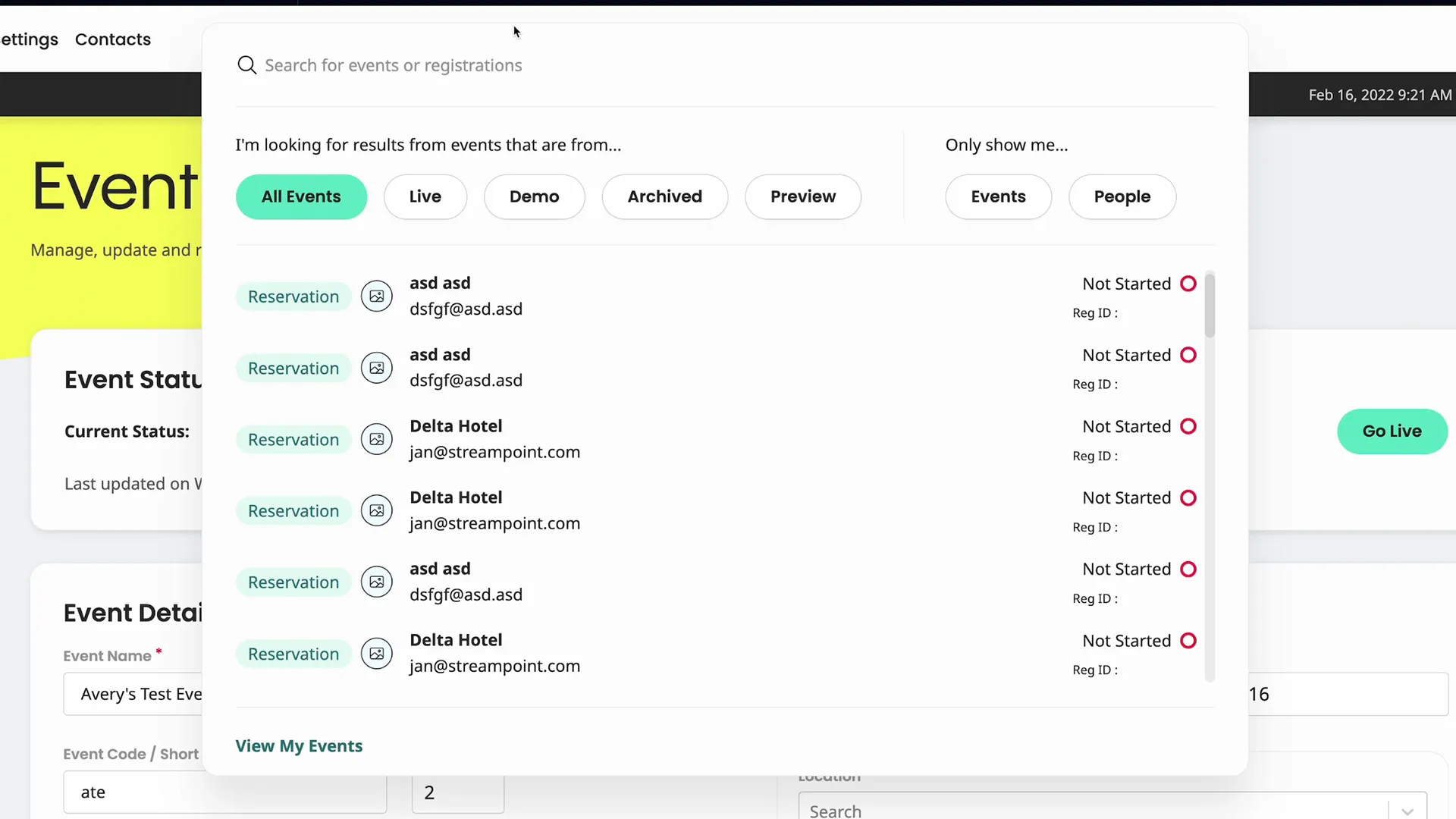
Unified search across Streampoint's event and attendee records, accessible from the top nav. Context-aware ranking surfaces results from the user's current page first. CS teams hit it dozens of times a shift; cuts time-to-find by 20%+.
Case highlights
20% ↓
Time to find
across user types in beta vs prior workflow
~60% eliminated
Secondary searches
context-aware ranking reduced double-searches
Single input
Surface
events + attendees in one unified result list
- Fragmented search. Separate pages for events vs attendees.
- Context-switching overhead. Different syntaxes and filter options per surface.
- Time-intensive workflows. Finding a specific attendee inside a specific event required multiple nav and filter steps.
Launch
Speed and accuracy
- 01 Time-to-find, target: 20%+ reduction.
- 02 First-attempt success rate for finding target results.
- 03 Adoption of advanced filtering features.
Strategy
Compound platform value
- 01 CS hours returned from navigation to support work.
- 02 Reduction in 'can't find' support tickets.
- 03 Engagement with platform features accessed through search.
- 04 Customer satisfaction scores for navigation.
- CS was already running a second search after the first returned a too-broad set. Context-aware ranking could eliminate ~half of secondaries.
- Competitive analysis on Salesforce, HubSpot, and event platforms: contextual ranking and unified-filter patterns are common.
- Indexing performance was the eng constraint. Progressive loading and pagination shaped the interaction model from the start.
Initial wireframes explored two approaches: a global-nav unified search vs a contextual search living inside each module. Mocked both, mapped edge cases, prototyped the preferred path.
Refinement collaborated with eng on indexing and pagination; the interaction model had to respect what the platform could handle.
REEL Open/close prototype
Animation prototype for the open/close behavior. Designed to make the search surface feel first-class, not grafted on, and to communicate processing during indexing delays.
REEL Production search
Final dev version. Single input, context-aware ranking, progressive loading on large datasets. Always one keystroke away from the global nav.
Context-aware ranking
Results rank against the user’s current page. If you’re in an event, that event’s attendees come first.
Single input, results from both
Don’t make users pick events vs attendees. Accept anything, then differentiate at the result level (icon, metadata, type chip).
Show loading clearly
Index time is real on massive datasets. The open/close animation and result-loading states communicate processing; users read the delay as “it’s working.”
-
~20% ↓
Time to find search results
Across all user types in beta. Expected to improve post-GA as more customers use it.
-
~60%
Secondary searches eliminated
Context-aware ranking reduced the CS 'search twice' pattern to a single search in the common case.
-
Unified
Search surface
Eliminated the need for separate event and attendee search pages.
Deep dive
Curious about the specifics?
Adoption cohorts, revenue pivot data, prototype walkthrough videos, and the internal PRD are available on request during a portfolio review.