
2022

Automations

Visual rules engine for Streampoint's B2B event platform. Cut developer configuration requests by 85% in beta by letting customer success teams build complex conditional logic themselves.
Automations

Case highlights

85% ↓

Dev config requests

during beta vs pre-launch baseline

Days saved

Event setup time

complex international events, eng off the critical path

Visual rule builder

Surface

nested conditions through hierarchy, no tree diagrams

Role
Senior Product Designer · Lead
Team
1 eng lead · 5 full stack devs
Timeframe
2022
Stakeholders
Engineering Leadership · Product Leadership · Customer Success Lead
01

Streampoint’s B2B event platform hit a scaling wall: every non-trivial event configuration required engineers to create the automations. Complex international events, geographic compliance rules, conditional content display, etc. The bottleneck capped account volume, delayed customer launches, and surfaced as a specific blocker during enterprise evaluations.

I led design on a self-serve visual rules engine that let event ops and customer success teams setup complex conditional logic without writing code. The interaction model balanced power-user capabilities (nested conditions, multi-depth rules, real-time evaluation) with accessibility for casual users who needed to handle common cases. Beta cut developer config requests by 85% and removed eng from the critical path on complex international events.

02
  1. Developer bottleneck. Every customer configuration request required engineering. Significant delays.
  2. Content personalization limits. Static event pages couldn’t adapt to attendee characteristics. Engagement and conversion suffered.
  3. Enterprise sales friction. Lack of advanced automation surfaced as a specific barrier during evaluations, especially for large organizations.

The growth ceiling was literally engineering capacity, because every new event setup was a ticket. The opportunity was compounding: move config from eng to self-serve, free eng for platform work, shorten enterprise sales cycles, and grow account volume without growing headcount.

03
01

Launch

Self-serve adoption

  • 01 Developer ticket reduction for configuration requests.
  • 02 Customer success teams handling configuration end-to-end.
  • 03 Rules engine adoption rate among existing customers.
  • 04 Configuration resolution time.
02

Strategy

Platform compounding

  • 01 Eng capacity returned to platform work.
  • 02 Enterprise deal velocity.
  • 03 Customer time-to-live on complex events.
  • 04 Differentiation against Cvent and Bizzabo.
04
  • Real-time rule evaluation is non-trivial. BE needed rework to support what the interaction model implied.
  • One builder, two distinct user types. Power users (nested rules) and occasional users (basic show/hide).
  • No-code assumption. Customers and CS are the target. Anything that looked like a code editor would fail.
  • Multi-depth conditional logic. Real events need nested conditions. The visual language had to express depth without becoming a tree diagram.
  • Competitive bar. Cvent and Bizzabo offered basic conditional logic but lacked intuitive visual builders.
05

Customer interviews surfaced two distinct automation needs: compliance-driven rules for regulated industries, and engagement-optimization rules for marketing teams. One builder had to serve both.

Competitive analysis on Cvent and Bizzabo confirmed feature parity wasn’t the bar. Both offered basic conditional logic. Neither had a visual builder that occasional users could learn without training.

Power users from CS were brought into the prototype loop early. Their multi-region compliance scenarios drove the depth features. The top priority was moving the workload from engineering to CS, so their scenarios were essential.

06

Wireframes-first to validate the interaction model with engineering before investing in high-fidelity. Real-time rule evaluation surfaced as a backend blocker at this stage and got reworked before high-fi started.

FIG Initial wireframe. Used to walk eng through the interaction model and surface BE feasibility questions before high-fi.
FIG Editing-state wireframe. Confirmed the in-place editing model and the trigger-condition-action scaffolding.

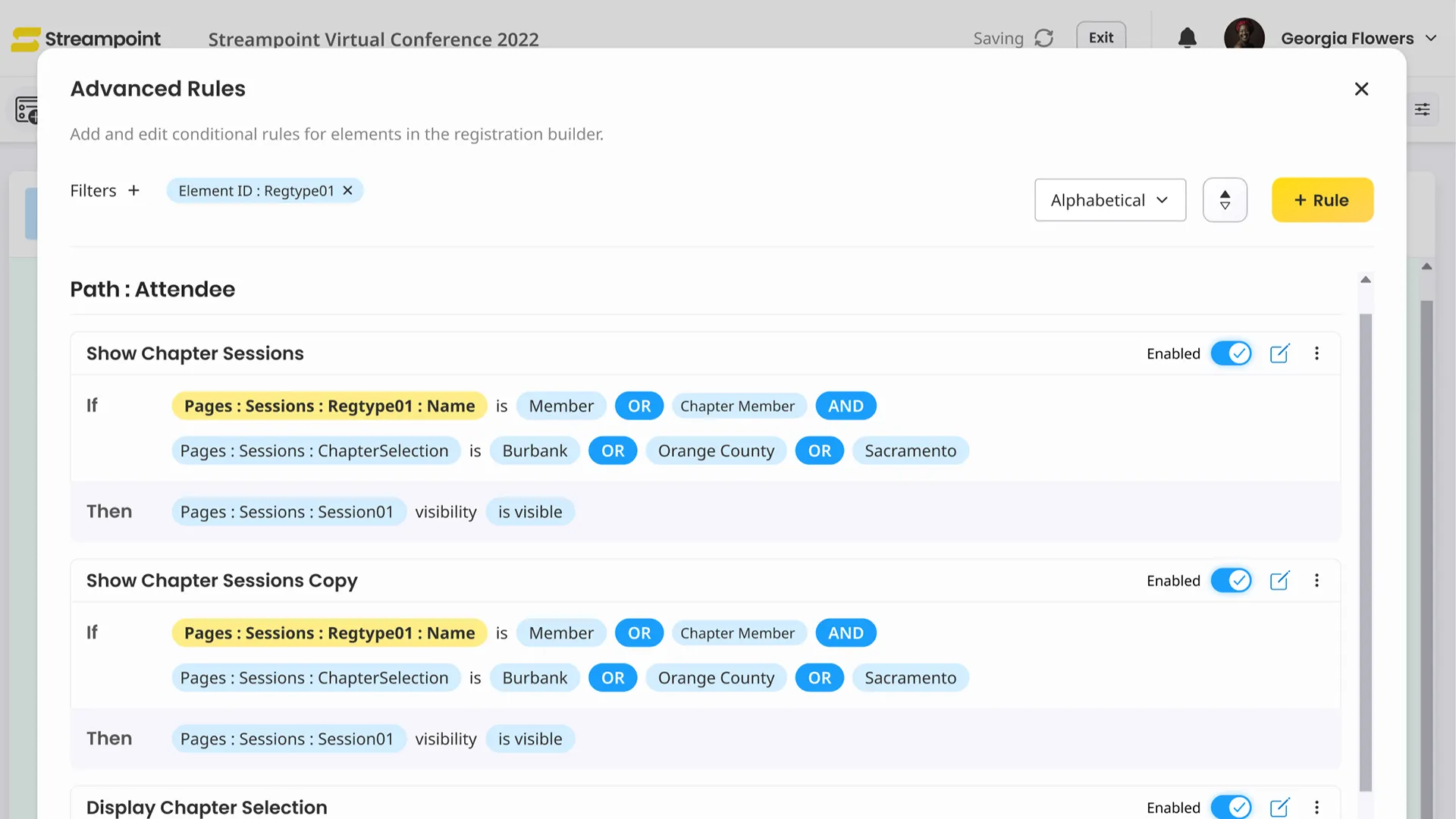
High-fidelity builder states. Same surface scales from a flat condition + action (occasional users) to multi-depth nested rules (power users).

FIG Empty state explains the mental model without requiring training. New users land here and start adding rules without setup.
FIG Simple-case builder: one condition, one action, flat. Covers the majority of use, lowest friction.
FIG Multi-depth nested conditions. Hierarchy expressed through indentation and grouping, scales to depth power users actually need.
FIG Fully configured rule for testing. Readable top-down by occasional users, editable top-to-bottom by power users.

REEL Final builder

Production rules engine in motion. Visual builder, real-time evaluation, accessible to CS teams without engineering involvement.

07
01

Visual builder, not code-like editor

Target users are customers and CS. A visual builder was the only form that could serve them. Accepted UI complexity in exchange for a fully self-serve experience.

02

Depth through hierarchy, not tree diagrams

Tree views are accurate but intimidating. Indentation, grouping, and visual hierarchy let occasional users read top-down without confronting a diagrammatic structure.

03

Feasibility review at low-fi

Walked the interaction model through eng at wireframe stage. Real-time rule evaluation surfaced as a BE gap that was corrected.

04

Power-user-informed iteration

Power users from CS were in the prototype loop from day one. Their multi-region compliance and regulated-industry scenarios drove the depth features.

08
  • 85% ↓

    Developer config requests

    During beta. Customers and CS handled the vast majority of logic themselves.

  • Days saved

    Event setup time

    Complex international events. Developer involvement removed from the critical path.

  • Closed

    Enterprise-evaluation blocker

    Advanced automation gap was a specific barrier during enterprise evaluations for global organizations. Resolved.

  • Unblocked

    Platform scalability

    Engineering capacity was the growth ceiling. Self-serve config compounds: eng time returns to platform work, customer time-to-live drops.

  • Two user types

    One builder

    Occasional users (basic show/hide) and power users (multi-region compliance) both served by the same surface.

09
  • Self-serve is a scaling essential. When setup tickets bottleneck growth, moving to self-serve compounds: eng time returns to platform work, customer time-to-live drops.
  • Visual builders sell themselves to non-technical users but have to be designed for power users. The depth has to be real or power users bounce back to eng tickets. Designing accessibility in without losing depth was the whole job.
  • Early feasibility review at low-fi saves mid-build rework. BE caught the real-time evaluation gap at wireframe stage. Avoided a rebuild.
  • If repeating: build CS enablement materials earlier. Adoption depended on CS being able to confidently onboard customers; those materials shipped later than ideal.

Deep dive

Curious about the specifics?

Adoption cohorts, revenue pivot data, prototype walkthrough videos, and the internal PRD are available on request during a portfolio review.