
2023–2024

CRM MVP

Built the CRM that took Roofr from a measurement and proposals suite to an operating system for roofers.
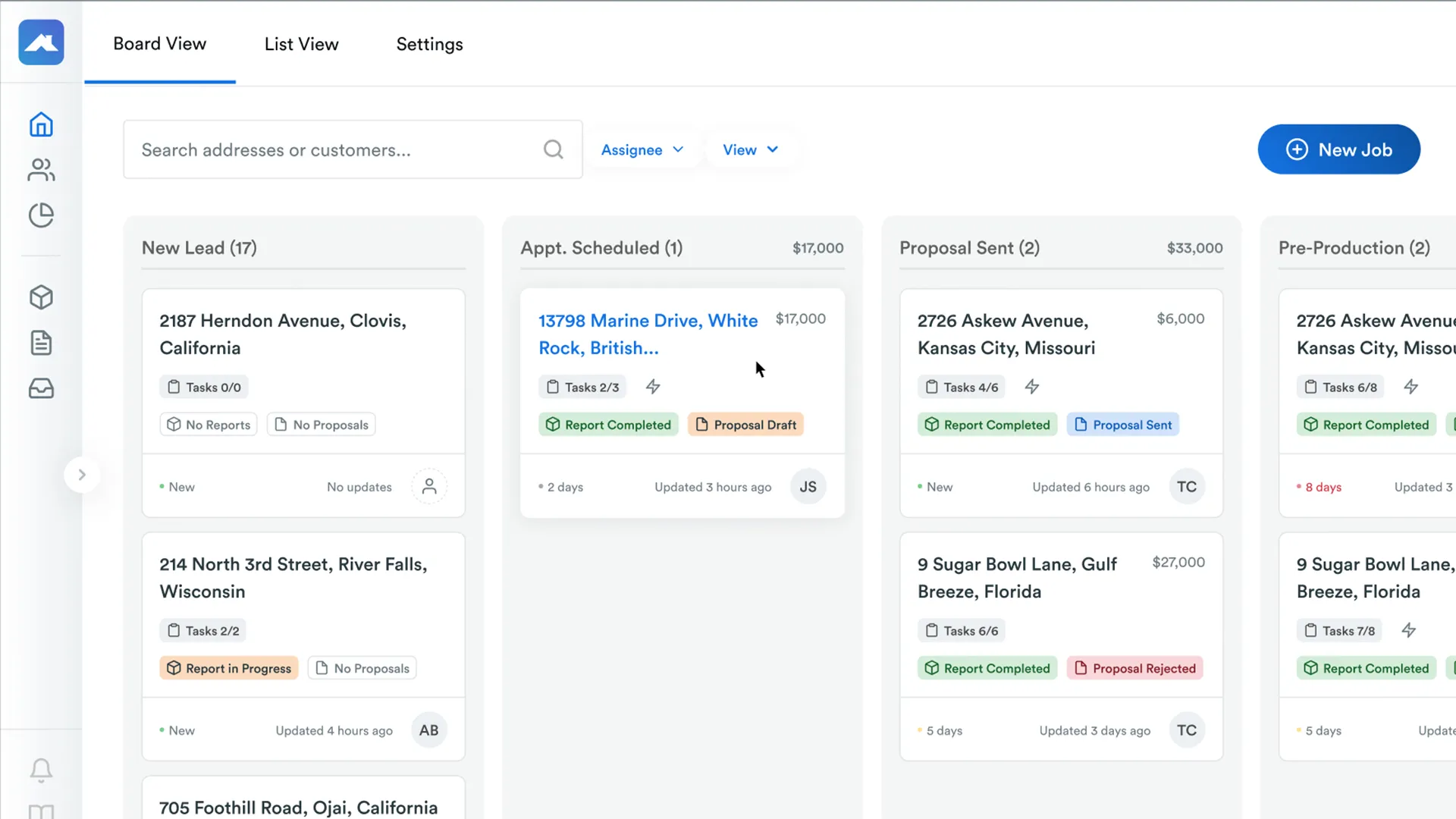
CRM MVP

Case highlights

0 → 2,400+

Adopted companies

active businesses running on the CRM by 2026

32.8%

Paid-tier adoption

of Elite subscribers using job stages / workflow

0 → 1,500

Monthly task completion

from zero to 1.5k monthly completions in year one

Role
Product Designer
Team
1 PM · 1 eng lead · 10 FE/BE devs
Timeframe
2023–2024
Stakeholders
CEO · Engineering Leadership · VP Product
01

Roofr was two tools (measurements and proposals) that contractors ran alongside a separate CRM. Every sales call surfaced the same gap: they wanted one place to run jobs from lead to close.

I led the 0-to-1 design end-to-end: problem framing, MVP scoping, interaction model, the high-fidelity prototype used for sales demos, the production spec, and post-launch iteration. The main direction was that the new entity connected existing Roofr entities (measurements, proposals, contacts) under a single new job umbrella.

02
  1. Roofr looked like a disconnected suite, not a platform. Expansion beyond measurement and proposals was capped.
  2. Contractors kept a separate CRM open alongside Roofr.
  3. Missing foundational CRM blocked the $2B construction-CRM category.

The category positioning itself was at stake. Without a CRM, Roofr was just a high-quality measurement tool. With a CRM, Roofr became the platform for a segment that bloated incumbents (JobNimbus, AccuLynx, JobProgress) were fumbling. The business-model pivot from transactional features to subscription revenue depended on this project clearing the bar.

03
01

Launch

Adoption signals

  • 01 Task completion rate among active users.
  • 02 File-attachment adoption as a platform-stickiness proxy.
  • 03 Workflow usage on paid-tier subscribers.
  • 04 Contact-flow engagement vs pre-CRM baseline.
02

Strategy

Category positioning

  • 01 Closed beta with 20+ roofing contractors before GA.
  • 02 Foundation for subscription-revenue expansion.
  • 03 Shift from "tools" to "platform" in sales conversations.
  • 04 Competitive positioning against JobNimbus, AccuLynx, JobProgress.
04
  • Existing entities can’t break. Measurements, proposals, and contacts were already in production with paying customers. The Jobs layer had to connect them, not replace them.
  • MVP scope vs 1-year vision. The initial PRD outlined automation, scheduling, and analytics that couldn’t ship in one release. Constant cross-functional re-alignment on what the MVP actually was.
  • Performance with large datasets. Eng raised early concerns that Kanban card rendering would degrade at high job counts.
  • Sellable before feature-complete. The business needed an sales-demoable story before full implementation. The interactive prototype became a pre-launch sales tool.
  • Primary user is an unentrenched contractor. Customers not heavily invested in a competing CRM were the realistic opportunity. Switcher-targeting was a future problem once we had feature parity.
05

Competitor platforms (JobNimbus, AccuLynx, JobProgress) offered bloated features that overwhelmed smaller ops. That left an opening for a focused, workflow-first MVP rather than matching feature count.

Customers didn’t want new isolated CRM features. They wanted existing Roofr functionality stitched into a cohesive job lifecycle. That reframed the build as a connector layer.

The roofing workflow is high-ambiguity with many edge cases to consider: contacts that aren’t yet jobs, jobs that never get proposals, measurements without jobs attached. The MVP had to support every real state without forcing data work before the first successful capture.

06
FIG Primary Kanban board. Cards represent jobs; columns are stages. Drag-to-advance with a fallback menu for large lists.
FIG Job detail connects existing measurements, proposals, contacts, and files. Activity feed surfaces cross-feature events so the job is the single source of truth.
FIG Elite-tier gating surfaced inline as an upgrade affordance.

REEL Final prototype

Interactive prototype used for enterprise prospect demos and beta onboarding. Shipped the story before the build was feature-complete; closed early adopters on the promise.

07
01

Jobs as the core

A Jobs layer connecting measurements, proposals, contacts, and files. Adoption followed this architecture.

02

Contactless jobs

Making contacts optional didn’t hurt contact engagement, which went up 25% → 34%.

03

Kanban homepage

The layout contractors already used in their mental models.

04

Prototype as a sales tool

Built with realistic contractor data for event sales demos and beta onboarding. Closed early deals on the promise before the real build was feature-complete.

05

Elite-tier gating

Advanced workflow features went behind the Elite paid tier, designed as an upgrade path. 32.8% Elite adoption validated the placement.

08
  • 0 → 2,400+

    Adopted companies

    Active businesses running on the CRM, not trial accounts. ~13x growth over 27 months from rough public launch 2024 to 2026; every month larger than the last.

  • 0 → 1,500

    Monthly task completions

    First-year peak. Averaged ~800/month across post-launch cohorts. Volume + sustained = workflow adoption, not novelty curiosity.

  • 32.8%

    Elite paid-tier adoption

    Of Elite subscribers updating job stages monthly.

  • 25% → 34%

    Contact usage

    Monthly contact-flow usage vs the pre-CRM baseline. Contactless-jobs increased contact creation and usage on the job.

  • 0 → 5.92%

    File-attachment DAU

    Of daily actives uploading files to jobs by 2025. It became a sticky-platform signal as contractors using the platform for attachments were likely heavily entrenched in it.

  • 20+

    Closed-beta contractors

    Successful qualification before release.

  • Tools → Platform

    Category shift

    Foundation of Roofr's subscription-revenue model shift away from transactional purchases.

Definition of adopted: Active subscriber, 1+ month into the lifecycle, completing the core loop (Job → Proposal → Invoice) or the expanded loop (Material Order / payment), sustained for 2+ months across a 15-month rolling window.

09
  • Scope negotiation is the real work. Cross-functional facilitation to land on “lead to close” mattered more than any screen.
  • Architecture beats feature count. Connecting existing entities produced more adoption lift than any new feature would have.
  • Prototypes are sales artifacts. The interactive prototype closed sales deals before the build existed.
  • Don’t let data cleanliness block capture. Making contacts optional pushed contact engagement up.
  • Start the performance conversation early. Eng-side rework on Kanban card rendering could have been smaller with better load testing.

Post-launch. The Jobs layer seeded Custom Workflows, Unified Inbox, automations, suppliers, and more. The foundational architecture we built is the basis for years of future work.

Deep dive

Curious about the specifics?

Adoption cohorts, revenue pivot data, prototype walkthrough videos, and the internal PRD are available on request during a portfolio review.