
 2025
2025 Unified Inbox
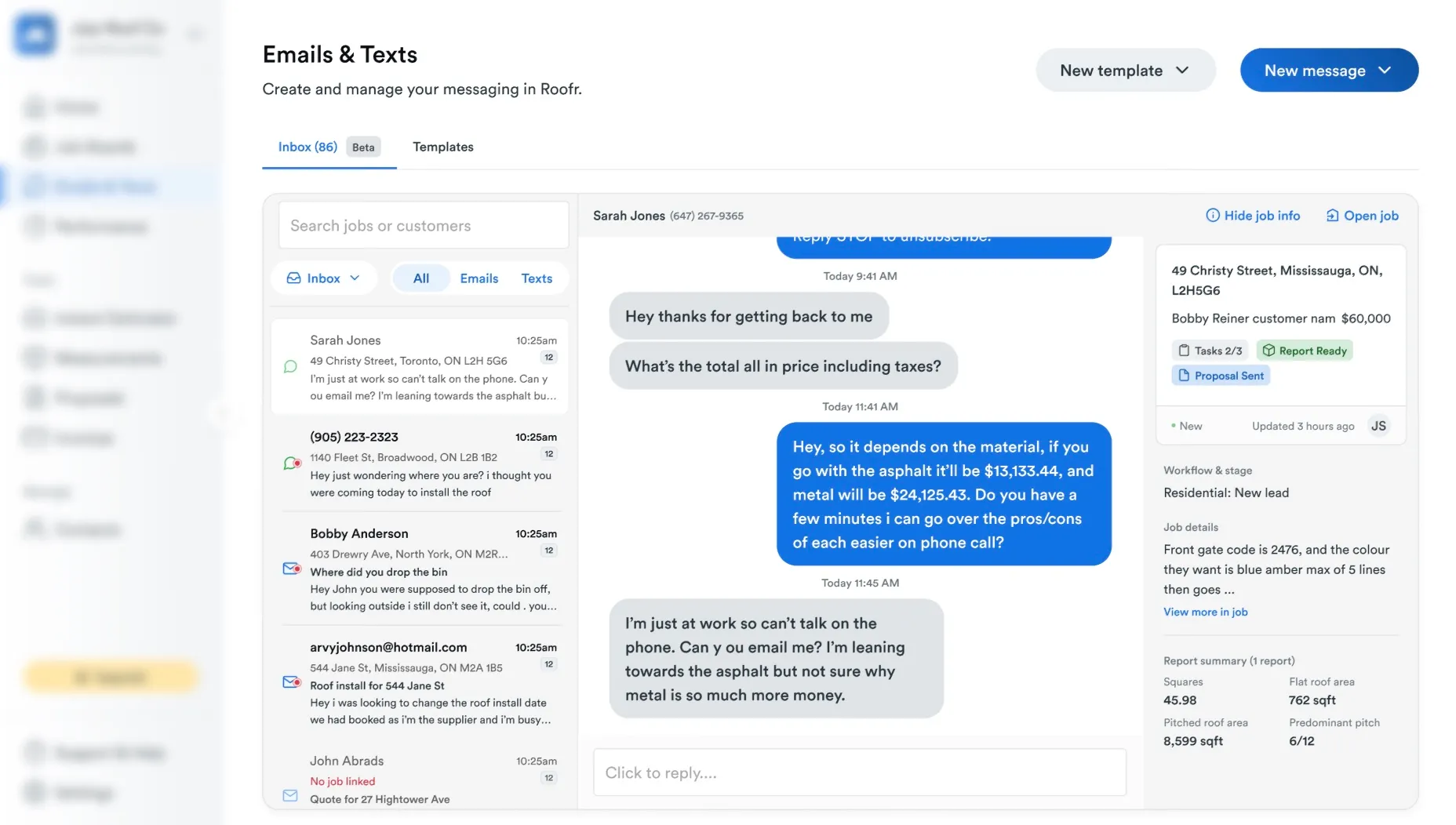
Led 0-to-1 design of Roofr's Unified Inbox. One hub for email and SMS across the platform, with a global view and per-job threads. Shipped as a paid add-on that became a revenue and stickiness driver.
Case highlights
0 → 259
Paid SMS adoption
companies on the paid SMS add-on by Apr 2026 (launched May 2025)
3.59%
Active-team conversion
of active CRM companies on the paid SMS add-on
11.24%
Gmail integration
of all active CRM companies
- Contractors couldn’t track inbound communications across channels. Operational inefficiencies, missed touchpoints, lost jobs.
- Job-level communication history was fragmented across emails, texts, notes. Context evaporated during handoffs.
- Roofr-branded communications degraded contractor credibility with their customers.
- No integrated comms tooling was a hard blocker during enterprise sales.
Launch
Adoption + setup
- 01 Adoption rate of Gmail integration setup.
- 02 Messages sent per team per month.
- 03 Churn reduction among teams that completed integration.
- 04 Phone-number application volume on the paid SMS add-on.
Strategy
Revenue + enterprise unblock
- 01 Revenue from the paid texting add-on subscription.
- 02 Enterprise deal closure rate improvement.
- 03 Eliminate the 'no real comms hub' sales objection.
- 04 Establish a foundation for follow-up comms feature expansion.
- Message-volume performance. The original CRM architecture wasn’t sized for conversation history at scale. Surfaced technical debt that required UI-side optimization and BE rework.
- The macro / micro split anchored the IA. Operations triage from the global inbox; job managers drop into individual threads.
- Construction software treated email as templated send forms (basically a sending form on a job). Gap pointed to a unified comms hub as a tiered feature.
The dual-plane IA: macro for operational triage, micro for deep project context.
Two views of the micro plane: filtered thread inside a job, and the surrounding job context the hub surfaces alongside the conversation.
The global-send composer in two stances: context-free from the inbox, context-bound from inside a job.
Mobile-ready. Ops teams triage on phones between site visits; the IA scales down without losing the macro / micro distinction.
REEL Final walkthrough
The Unified Inbox in production. Macro inbox at the top, click into a job thread for context, send across channels from either plane.
REEL Pitch · job context
Job-detail view with comms inline. Activity log surfaces email events alongside other job actions; Compose lives at the job level.
REEL Pitch · global inbox
Global Communications inbox. Cross-channel message list with thread view and inline reply.
Macro / micro IA split
Global inbox (operational triage) plus job-scoped threads (project context), sharing the same conversation data with separate composers.
Contractor-owned sender identity
Outbound from the contractor’s email and phone number. Required external integration setup but unlocked adoption.
Paid texting tier
Phone-number registration and per-message sending carry real costs; pricing the add-on covered them and made texting into a revenue line.
-
0 → 259
Paid SMS companies
May 2025 launch to Apr 2026. New revenue stream.
-
3.59%
Active-team conversion
Of active CRM companies on the paid SMS add-on.
-
11.24%
Gmail integration rate
Of all active CRM companies running a verified Gmail integration.
-
28.66%
Automation attach
Of Gmail-integrated companies layer proposal / invoice automations on top. The dominant cross-channel pattern: contractors connect inbox, then add automations.
-
300+
Texting DAU
Daily active subscribers on the SMS add-on.
-
Sales unblocked
Common objection removed
The 'no real comms hub' blocker stopped surfacing after launch.
Deep dive
Curious about the specifics?
Adoption cohorts, revenue pivot data, prototype walkthrough videos, and the internal PRD are available on request during a portfolio review.